
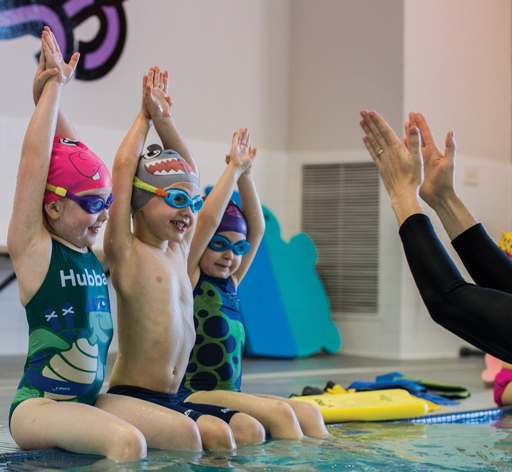
Match the lesson to what the swimmer can do comfortably, not simply their age or a friend’s badge. These five providers of swimming lessons in Liverpool advertise different routes into the water, from preschool sessions to group and individual teaching. Numbering organises the choices rather than ranks independently assessed instruction. Lessons build skills but don’t make a child drown-proof or remove the need for close adult supervision in and around water, including when lifeguards are present.
Keep ideas found through Keep Scrolling Notes separate from the swimmer information you give the school, particularly previous experience and any difficulty that affects participation.
1. Swim Academy Liverpool
Liverpool’s Lifestyles service advertises lessons across several centres following Swim England programmes. Its published offer includes adult-and-child preschool sessions, children’s lessons from age four and adult lessons.
It is a useful starting point when the family needs to compare locations and age routes through one public service. Confirm the actual centre and group before applying. Say a child is comfortable playing in shallow water but hasn’t joined a lesson without a parent. Ask how placement is assessed rather than assuming confidence at play equals readiness for a particular teaching stage.
2. University of Liverpool, Active Liverpool
The university advertises children’s lessons at its Sports and Fitness Centre on Bedford Street North. Its published offer includes a Swim England programme for ages four to sixteen and separate one-to-one instruction.
It provides a comparison between group learning and individual support. Ask which format fits the learner’s current needs and how progress is reviewed. Think of placement like choosing the right reading group: the useful match is the skill being learned, not simply who happens to be the same age. A private lesson isn’t automatically necessary, but the option can be worth discussing.
If Tell It Swim helps you gather activity ideas, confirm the actual eligibility and booking process with the teaching provider rather than assuming university facilities are only for students.
3. Angie’s Swim School
Angie’s Swim School advertises Liverpool lessons for children and adults, including group, one-to-one and more advanced sessions. Its published range gives families another provider to approach for an assessment of the suitable route.
Ask where the intended class takes place and how lessons are organised. Don’t treat a business name as a confirmed pool address. If a swimmer is anxious about a particular part of the lesson, describe that explicitly instead of requesting only a “beginner class”. The school needs the actual starting point to discuss what support it can offer and what expectations apply.
4. Swimsound
Swimsound advertises children’s lessons in Liverpool for ages three to sixteen and identifies itself as following the Swim England Learn to Swim Programme. Its published description covers beginner and more advanced learning.
It is a candidate when a family wants to understand progression through a defined framework. Ask how the initial stage is selected and how the instructor communicates the next skill to practise. A badge can record an achievement, but the useful conversation is what the child can now do and what still needs work. Don’t assume a certificate removes the need to discuss supervision or confidence.
Keep general reading through Wave of Water Thoughts apart from progress information supplied by the teacher; the latter should explain the swimmer’s own abilities rather than a typical timetable.
5. Swim! Liverpool South
Swim! lists its Liverpool South venue on Triumph Way in Speke and advertises sessions for ages zero to eleven. Its published model includes small groups and teachers in the water with beginners.
That makes it relevant to a parent investigating early-years or beginner arrangements. Ask which group fits the child and whether a parent joins the water for that specific class. A provider’s overall age range doesn’t explain each session’s format. Confirm changing, arrival and handover arrangements too, particularly if another adult will take the child on some weeks.
Choose swimming lessons in Liverpool around learning conditions
Compare the actual lesson: pool setting, group size, teacher position and how instructions reach the learner. Ask what happens if a child needs more time with one skill. Different formats can be appropriate, but the explanation should relate to the child rather than a universal promise of fast progress.
For an illustrative family, a convenient session that can be attended consistently may be more workable than a preferred venue requiring a difficult journey. Balance the teaching arrangement with the routine you can sustain. No lesson-completion times are promised here.
A resource such as Content Drop Swimming cannot replace water-safety guidance. The American Academy of Pediatrics and CDC emphasise that lessons are only one layer of protection and that children still need close, attentive supervision. My rule is to discuss ability and supervision separately: progress in one doesn’t cancel the other.